Duce
Here For The Long Haul!
- Local time
- 4:02 AM
- User ID
- 809
- Joined
- Feb 6, 2016
- Messages
- 2,347
- Reaction score
- 8,172
- Location
- Roscommon, MI

In 2004 I owed a ford f350 6.0 and could not get rid of it fast enough. More time at dealer than with me.





In 2004 I owed a ford f350 6.0 and could not get rid of it fast enough. More time at dealer than with me.

Here is my daily fix for my 1998 F250, coolant temp gauge has been flaky and today on my way home from work, didn't lift off of the bottom of the gauge, heater blew cold air the whole way home. The coolant reservoir was was full and overflowing a little (due to the thermostat not opening up). Tested the gauge (shorting out the pins on the connector) and the gauge pegged hot. Went to O'Riley's and got one of their AM temp sensors and it didn't work (it fit, but didn't register anything), I wasn't surprised, the reviews weren't that great, but everything else was closed. I thought I would meter out the sensors and see what they say here is what I found:
* O'Riley's states that the manufacture range should be between 27,000 and 31,000 ohms (not sure if that is just the ambient temp range or the hot/cold range)
* The original OEM sensor metered out at 6,000 (cold 70F water) and dropped to around 500 ohms in 212F water.
* The AM sensor metered out at 28,000 (cold) and dropped to about 24,000 ohms in 212F water.
I ended up cleaning the corrosion off of the OEM sensor with a brass brush and scotch bright and reinstalled it and it ended up working. I will use it for now until I can order an OEM replacement.
My question surrounds the resistance readings from the sensors, should it be a specific ohm range these work in or is it more of a percentage of resistance? I am using a Fluke digital multi-meter that is auto sensing.

The quoted value by O'Reilly was their quoting the "manufacture's information", I am assuming they were quoting Ford or something Ford published. They didn't site their source so I guess it could have been made up - maybe they quoted Google AI...I'm surprised you were able to find a published Ohm value for the O'Reilly sensor.

That is what I thought too, but perplexing that the OEM is 80% working (it seemed to quit as I was driving home, needle settled to the bottom, but resurrected as I had to drive up the hill to Tractor Supply and worked for the rest of the day) and the AM didn't work at all.I would think the replacement sensor should be at least close to the factory Ohm spec, otherwise the ECM couldn't work with it.

Here is my daily fix for my 1998 F250, coolant temp gauge has been flaky and today on my way home from work, didn't lift off of the bottom of the gauge, heater blew cold air the whole way home. The coolant reservoir was was full and overflowing a little (due to the thermostat not opening up). Tested the gauge (shorting out the pins on the connector) and the gauge pegged hot. Went to O'Riley's and got one of their AM temp sensors and it didn't work (it fit, but didn't register anything), I wasn't surprised, the reviews weren't that great, but everything else was closed. I thought I would meter out the sensors and see what they say here is what I found:
* O'Riley's states that the manufacture range should be between 27,000 and 31,000 ohms (not sure if that is just the ambient temp range or the hot/cold range)
* The original OEM sensor metered out at 6,000 (cold 70F water) and dropped to around 500 ohms in 212F water.
* The AM sensor metered out at 28,000 (cold) and dropped to about 24,000 ohms in 212F water.
I ended up cleaning the corrosion off of the OEM sensor with a brass brush and scotch bright and reinstalled it and it ended up working. I will use it for now until I can order an OEM replacement.
My question surrounds the resistance readings from the sensors, should it be a specific ohm range these work in or is it more of a percentage of resistance? I am using a Fluke digital multi-meter that is auto sensing.
I guess that is a possibility, I replaced it less than a 1,000 miles ago, but I may have to revisit possibly replacing that again.Sounds like you're temp sensor is working ok, it's your thermostat that is stuck open not allowing the coolant temp to rise. That would be why you have no heat too.
I guess that is a possibility, I replaced it less than a 1,000 miles ago, but I may have to revisit possibly replacing that again.
Today when I drove to work, everything was working fine (needle movement and heat). When I drove home, about a mile from the house, the needle on the gauge started going down and the heater air started cooling) and when I parked at the house with it running, the needle settled at the bottom. I left the house and about a mile later, the needle on the gauge started creeping back up to it's normal warm position and it worked fine for the rest of the day.

Didn't you mention a head gasket issue in an earlier post? If any air got into the cooling system, it will have exactly the issues you're having.I guess that is a possibility, I replaced it less than a 1,000 miles ago, but I may have to revisit possibly replacing that again.
Today when I drove to work, everything was working fine (needle movement and heat). When I drove home, about a mile from the house, the needle on the gauge started going down and the heater air started cooling) and when I parked at the house with it running, the needle settled at the bottom. I left the house and about a mile later, the needle on the gauge started creeping back up to it's normal warm position and it worked fine for the rest of the day.
Yes I did. I had wondered about that, kind of hoping it was a bad sensor and not an air leak. That make a lot of sense with the randomness of the sensor not working and then working again. Not what I wanted to hear, but what I needed to hear, I do appreciate it.Didn't you mention a head gasket issue in an earlier post? If any air got into the cooling system, it will have exactly the issues you're having.

Geeze, I can relate. I think it foolish that folks would make these goofy youtube videos claiming theyre the best or "most reliable".Definitely been there. The only two things in the front end of my 03 7.3L between my hands and the pavement that I haven't replaced are the steering wheel itself and the column shaft.
Geeze, I can relate. I think it foolish that folks would make these goofy youtube videos claiming theyre the best or "most reliable".
These 7.3 powerstroke trucks are over 20+years old and most are high enough mileage where literally everything has to be replaced. Foolish to sensationlize old clapped out sht. They're only decent trucks if you've done the work to replace/rebuild a steaming pile of sht with high miles. No matter what the truck brand, yes even Toyota.
My buddy is still caught up on 80 series landcruisers. Him and I have wrenched on dozens of em. Same deal, theyre clapped out steaming piles of sht. They were nice 15 years ago. Toyota fan boys are a weird bunch.
I guess that is a possibility, I replaced it less than a 1,000 miles ago, but I may have to revisit possibly replacing that again.
Today when I drove to work, everything was working fine (needle movement and heat). When I drove home, about a mile from the house, the needle on the gauge started going down and the heater air started cooling) and when I parked at the house with it running, the needle settled at the bottom. I left the house and about a mile later, the needle on the gauge started creeping back up to it's normal warm position and it worked fine for the rest of the day.
I think this is the one that I got. I will have to check out what Napa has.Do you recall what brand thermostat you used? That is one part where it never pays to go cheap
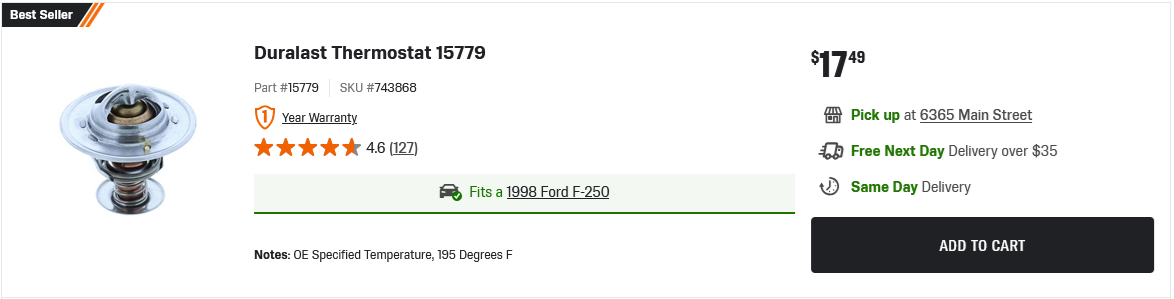
I have migrated to our O'Riley's and started going to our Napa after it took over the CarQuest shop.Eee, there's your problem right there. Stay away from AutoZone parts!

Toyota's 2UZ-FE is probably one of the best engines ever. I looked at several with that engine before buying one and they were all leak free other than the valve cover which are easy to do. But yeah people buying a 7.3 because they're"reliable" is crazy. A Toyota 2UZ-FE is probably the one engine I'd buy with 300k+ and still expect it to be halfway reliable.Geeze, I can relate. I think it foolish that folks would make these goofy youtube videos claiming theyre the best or "most reliable".
These 7.3 powerstroke trucks are over 20+years old and most are high enough mileage where literally everything has to be replaced. Foolish to sensationlize old clapped out sht. They're only decent trucks if you've done the work to replace/rebuild a steaming pile of sht with high miles. No matter what the truck brand, yes even Toyota.
My buddy is still caught up on 80 series landcruisers. Him and I have wrenched on dozens of em. Same deal, theyre clapped out steaming piles of sht. They were nice 15 years ago. Toyota fan boys are a weird bunch.