



You are using an out of date browser. It may not display this or other websites correctly.
You should upgrade or use an alternative browser.
You should upgrade or use an alternative browser.
Making my own flywheel pullers for Stihl equipment (and possibly others)

bwalker
Pinnacle OPE Member
- Local time
- 10:05 PM
- User ID
- 523
- Joined
- Jan 12, 2016
- Messages
- 2,235
- Reaction score
- 5,306
- Location
- Montana

If needed, yes.Wow........Do you also use a screwdriver as a crowbar.
Random thought..............If spending $10 for the proper tool or a few minutes building one will starve your family then you might not want to working on saws
As for proper tools. Most dealers do the same thing.

- Local time
- 9:05 PM
- User ID
- 14743
- Joined
- Nov 29, 2020
- Messages
- 1,193
- Reaction score
- 7,323
- Location
- MS
Having the right tool is a joy, no doubt. But there's a certain satisfaction in making do with a piece of 550, a piece cut off an old rubber boot, and a wine cork.
And really, if you don't have a bfh and a torch, pursuits involving things made out of metal might bring you sadness.
And really, if you don't have a bfh and a torch, pursuits involving things made out of metal might bring you sadness.

morfikov
Active OPE Member

If I had one, I would do that.The dukes one says in the picture m22x1.5 and m26x1.5. or just measure the saw ur working on.
 But currently I don't have any. Basically I have the opportunity to make such pullers (or adapters) virtually for free, at least for now. Who knows what I'll be facing in a year or two. That's why I'm looking for the specs of the most common tools used in repairs and try to make them. For instance, I also made the adapters for NGK spark plugs (all of the common threads), also the cost of one is under $1, but the quality is....
I have another question? What are the common thread sizes of flywheels? I mean in general, for any small engine equipment.
DillonBuck
Well-Known OPE Member
Dishonest much?Purchase this, obtain dimensions, send it back for refund.
flywheel puller extractor fits Stihl AV 042 048 050 051 064 066 075 0, 10,99 €
flywheel puller extractor fits Stihl AV 042 048 050 051 064 066 075 076 084 088 MS640 650 660 661 880 070 090 TS510 TS760 chrome galvanized steel Rotatableshop.saegenspezi.de

AVB
Super OPE Member
Any particular reason why a M8-1.00 flywheel knocker won't dismount the flywheel?
BTW I do have the 1110 890 4500 in the shop but can't open door due to ICE stopping me. Oh well maybe in a week I can open the door.
But you should be give up some beer and cancer sticks for one without someone having to put you in the nut house.
Two in one puller Aftermarket
BTW I do have the 1110 890 4500 in the shop but can't open door due to ICE stopping me. Oh well maybe in a week I can open the door.
But you should be give up some beer and cancer sticks for one without someone having to put you in the nut house.
Two in one puller Aftermarket
Last edited:
morfikov
Active OPE Member
Hammering the crankshaft isn't really good for it, so I try to avoid it.Any particular reason why a M8-1.00 flywheel knocker won't dismount the flywheel?
BTW I do have the 1110 890 4500 in the shop but can't open door due to ICE stopping me. Oh well maybe in a week I can open the door.
But you should be give up some beer and cancer sticks for one without someone having to put you in the nut house.
Two in one puller Aftermarket
I can wait till you get there.

AVB
Super OPE Member
Welcome to metal tariffs if in the USA.
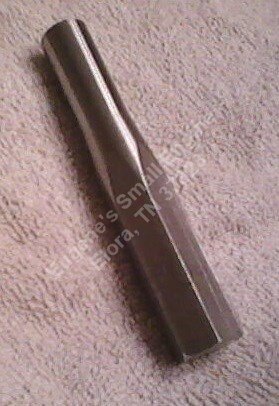
My lord all you need most times is a Flywheel Knocker. It is thread on the crankshaft end at the flywheel all the way and then backed off one to two turns. Then hit the end with a soft hammer to bump the flywheel off the taper. Usually only take one hit but several may be needed if someone over torqued the retaining nut or the key is sheared. Just don't go hog wild smacking the tool or you will damage the threads. And could use a couple of small wedges during this time to take the bearings play but not necessary most times.
In this case it would be threaded M8-1.00 and have an OD the same as the nut across the opposite corners in the rounded section. Basically you are using the weight of the flywheel and slight play in the bearings to bump it off. You then remove the tool and lift off the flywheel. If there is a stator underneath the flywheel then there will be some magnetic resistance.
The one pictured below is one of few I had made for various handheld two cycle engines. I had them made out stainless steel just because I don't like my tools rusting. The hex end is so the tool can be easily installed and removed.
My lord all you need most times is a Flywheel Knocker. It is thread on the crankshaft end at the flywheel all the way and then backed off one to two turns. Then hit the end with a soft hammer to bump the flywheel off the taper. Usually only take one hit but several may be needed if someone over torqued the retaining nut or the key is sheared. Just don't go hog wild smacking the tool or you will damage the threads. And could use a couple of small wedges during this time to take the bearings play but not necessary most times.
In this case it would be threaded M8-1.00 and have an OD the same as the nut across the opposite corners in the rounded section. Basically you are using the weight of the flywheel and slight play in the bearings to bump it off. You then remove the tool and lift off the flywheel. If there is a stator underneath the flywheel then there will be some magnetic resistance.
The one pictured below is one of few I had made for various handheld two cycle engines. I had them made out stainless steel just because I don't like my tools rusting. The hex end is so the tool can be easily installed and removed.

cuinrearview
Handy dood
- Local time
- 10:05 PM
- User ID
- 9248
- Joined
- Apr 16, 2019
- Messages
- 11,630
- Reaction score
- 80,609
- Location
- Dowling, MI
Which is really no different than backing the nut off flush with the end of the crank and tapping it with a brass hammer, but Rube Goldberg got famous for a reason...Welcome to metal tariffs if in the USA.
My lord all you need most times is a Flywheel Knocker. It is thread on the crankshaft end at the flywheel all the way and then backed off one to two turns. Then hit the end with a soft hammer to bump the flywheel off the taper. Usually only take one hit but several may be needed if someone over torqued the retaining nut or the key is sheared. Just don't go hog wild smacking the tool or you will damage the threads. And could use a couple of small wedges during this time to take the bearings play but not necessary most times.
In this case it would be threaded M8-1.00 and have an OD the same as the nut across the opposite corners in the rounded section. Basically you are using the weight of the flywheel and slight play in the bearings to bump it off. You then remove the tool and lift off the flywheel. If there is a stator underneath the flywheel then there will be some magnetic resistance.
The one pictured below is one of few I had made for various handheld two cycle engines. I had them made out stainless steel just because I don't like my tools rusting. The hex end is so the tool can be easily installed and removed.
View attachment 481804
AVB
Super OPE Member
Well it does gives the user less of a chance damaging flywheel fins miss lick and especially in a recessed holes like this Stihl has. Not all of us have prefect aim. An example is the bathroom fixture that gets wet all over the place.Which is really no different than backing the nut off flush with the end of the crank and tapping it with a brass hammer, but Rube Goldberg got famous for a reason...
Note the external threads on the Stihl tool are 1.5mm thread pitch.
morfikov
Active OPE Member
It's not about the crankshaft threads I'm talking about. Many service guys told me "do not hammer the crankshaft", and I asked why? They usually were telling me that the crankshaft isn't just a straight bar that goes through the machine's engine, it has it's "unique shape" and hitting one of the ends could potentially make bad things to the shape. Also they were saying something about crank seals. I already have a set of the tap pullers, but I need a set of those that you screw on the flywheel, to avoid hammering the crankshaft when I have that opportunity.Welcome to metal tariffs if in the USA.
My lord all you need most times is a Flywheel Knocker. It is thread on the crankshaft end at the flywheel all the way and then backed off one to two turns. Then hit the end with a soft hammer to bump the flywheel off the taper. Usually only take one hit but several may be needed if someone over torqued the retaining nut or the key is sheared. Just don't go hog wild smacking the tool or you will damage the threads. And could use a couple of small wedges during this time to take the bearings play but not necessary most times.
In this case it would be threaded M8-1.00 and have an OD the same as the nut across the opposite corners in the rounded section. Basically you are using the weight of the flywheel and slight play in the bearings to bump it off. You then remove the tool and lift off the flywheel. If there is a stator underneath the flywheel then there will be some magnetic resistance.
The one pictured below is one of few I had made for various handheld two cycle engines. I had them made out stainless steel just because I don't like my tools rusting. The hex end is so the tool can be easily installed and removed.
View attachment 481804
Here's one in action on my MS181:
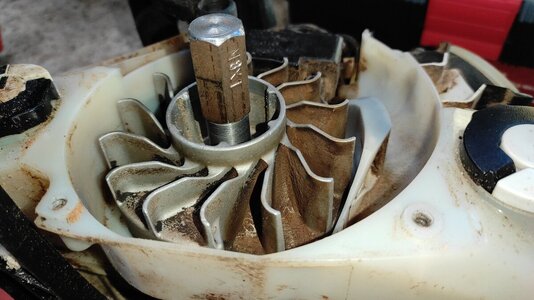
AVB
Super OPE Member
Well most of us have enough common sense to know you don't go at it the proverb-able sledge hammer force. I use a 2# brass hammer. You use no more force than necessary and not get in big hurry. I have yet to damage a crank, bearing, or seal. Although seals are usually the reason I pull a flywheel. One reason is the amount play in the bearings and doesn't to jar something off a taper; unless, you're like one fool here used an impact on his mower engine flywheel not. He basically fused the flywheel to the crank. And even using the correct OEM I destroyed the crankshaft end. The flywheel had to come off no matter what as was hitting the screws of the crankcase.
Beside I would worry more about twisting those pressed together cranks on some of engines I have seen. Yes if you hit the ends with extreme force you can do some damage.
Now if you have the equipment and the time then making the puller that Stihl has is fine too besides it keep your ability sharpen up.
And I need to buy myself one those combination milling and lathe machines myself since my machinist retired beside he could borrow it too.
Beside I would worry more about twisting those pressed together cranks on some of engines I have seen. Yes if you hit the ends with extreme force you can do some damage.
Now if you have the equipment and the time then making the puller that Stihl has is fine too besides it keep your ability sharpen up.
And I need to buy myself one those combination milling and lathe machines myself since my machinist retired beside he could borrow it too.
bwalker
Pinnacle OPE Member
- Local time
- 10:05 PM
- User ID
- 523
- Joined
- Jan 12, 2016
- Messages
- 2,235
- Reaction score
- 5,306
- Location
- Montana
Done properly it doesn't hurt a thing and I have been doing it for 30+ years. Of course some guys can break a anvilHammering the crankshaft isn't really good for it, so I try to avoid it.
I can wait till you get there.
bwalker
Pinnacle OPE Member
- Local time
- 10:05 PM
- User ID
- 523
- Joined
- Jan 12, 2016
- Messages
- 2,235
- Reaction score
- 5,306
- Location
- Montana
Some of these guys got alot of time and money to waste.Which is really no different than backing the nut off flush with the end of the crank and tapping it with a brass hammer, but Rube Goldberg got famous for a reason...
bwalker
Pinnacle OPE Member
- Local time
- 10:05 PM
- User ID
- 523
- Joined
- Jan 12, 2016
- Messages
- 2,235
- Reaction score
- 5,306
- Location
- Montana
I think they are making stuff up to be honest.It's not about the crankshaft threads I'm talking about. Many service guys told me "do not hammer the crankshaft", and I asked why? They usually were telling me that the crankshaft isn't just a straight bar that goes through the machine's engine, it has it's "unique shape" and hitting one of the ends could potentially make bad things to the shape. Also they were saying something about crank seals. I already have a set of the tap pullers, but I need a set of those that you screw on the flywheel, to avoid hammering the crankshaft when I have that opportunity.
Here's one in action on my MS181:
View attachment 481814
bwalker
Pinnacle OPE Member
- Local time
- 10:05 PM
- User ID
- 523
- Joined
- Jan 12, 2016
- Messages
- 2,235
- Reaction score
- 5,306
- Location
- Montana
As with anything in life, a little common sense goes along way.Well most of us have enough common sense to know you don't go at it the proverb-able sledge hammer force. I use a 2# brass hammer. You use no more force than necessary and not get in big hurry. I have yet to damage a crank, bearing, or seal. Although seals are usually the reason I pull a flywheel. One reason is the amount play in the bearings and doesn't to jar something off a taper; unless, you're like one fool here used an impact on his mower engine flywheel not. He basically fused the flywheel to the crank. And even using the correct OEM I destroyed the crankshaft end. The flywheel had to come off no matter what as was hitting the screws of the crankcase.
Beside I would worry more about twisting those pressed together cranks on some of engines I have seen. Yes if you hit the ends with extreme force you can do some damage.
Now if you have the equipment and the time then making the puller that Stihl has is fine too besides it keep your ability sharpen up.
And I need to buy myself one those combination milling and lathe machines myself since my machinist retired beside he could borrow it too.

Al Smith
Here For The Long Haul!
- Local time
- 10:05 PM
- User ID
- 537
- Joined
- Jan 14, 2016
- Messages
- 6,714
- Reaction score
- 15,028
- Location
- North western Ohio
At one time the only place you could find those pullers was through a Stihl dealer and rather costly .I made them by using metric hydraulic banjo fittings that had the correct thread size .Now of days you can find them rather inexpensively. If I can find out where in the world I did with those things I'll snap a picture .If I'm not mistaken those threads are metric pipe threads .
Al Smith
Here For The Long Haul!
- Local time
- 10:05 PM
- User ID
- 537
- Joined
- Jan 14, 2016
- Messages
- 6,714
- Reaction score
- 15,028
- Location
- North western Ohio
Sidetrack regarding metric threads cut on a lathe .Firstly I have one of the finest toolmakers lathes ever built which at the moment is not operational ,Monarch 10 EE .That said I don't have the change gears to allow it to cut metric threads so I had to find another way .Seek and ye shall find so I did and found the answer on You Tube .Using a tap as a tool with the same thread spacing .SAE sizes are threads per inch,metric is thread spacing .So following that You Tube directions I can do it but it's a long drawn out affair .Saying all that considering how inexpensive these after market Stihl flywheel pullers are the best method .I mean what the hey,under 20 bucks and they work .
legdelimber
Pinnacle OPE Member
- Local time
- 10:05 PM
- User ID
- 8391
- Joined
- Jan 14, 2019
- Messages
- 855
- Reaction score
- 2,177
- Location
- N.C.
My head sorta feels funny from trying envision the rigging to let the tap feed at the correct rate to match the pitch, if ya ain't got the feed gears.
I'm kind thinking of something like a tapping head. Still lets the tap pull itself but mounted way offset.
I assume you're letting the tap work like a turning tool.
If you mounted the tap on the tool post, I'm almost seeing an air line connection into the saddle, so that it would float easily enough to let the tap move it.
Heck, tapping head mounted on the tool post?
Then I may just be too low on caffeine to be thinking this kind of stuff today.
I'm kind thinking of something like a tapping head. Still lets the tap pull itself but mounted way offset.
I assume you're letting the tap work like a turning tool.
If you mounted the tap on the tool post, I'm almost seeing an air line connection into the saddle, so that it would float easily enough to let the tap move it.
Heck, tapping head mounted on the tool post?
Then I may just be too low on caffeine to be thinking this kind of stuff today.
bwalker
Pinnacle OPE Member
- Local time
- 10:05 PM
- User ID
- 523
- Joined
- Jan 12, 2016
- Messages
- 2,235
- Reaction score
- 5,306
- Location
- Montana
If it were me I would find a bolt.of the right size then bore a hole through the center and be done with it. No need to cut threads.Sidetrack regarding metric threads cut on a lathe .Firstly I have one of the finest toolmakers lathes ever built which at the moment is not operational ,Monarch 10 EE .That said I don't have the change gears to allow it to cut metric threads so I had to find another way .Seek and ye shall find so I did and found the answer on You Tube .Using a tap as a tool with the same thread spacing .SAE sizes are threads per inch,metric is thread spacing .So following that You Tube directions I can do it but it's a long drawn out affair .Saying all that considering how inexpensive these after market Stihl flywheel pullers are the best method .I mean what the hey,under 20 bucks and they work .
Of course I would probably just stick to a brass hammer...
Last edited:
Similar threads
- Replies
- 113
- Views
- 20K


- Replies
- 10
- Views
- 2K
- Replies
- 12
- Views
- 3K

