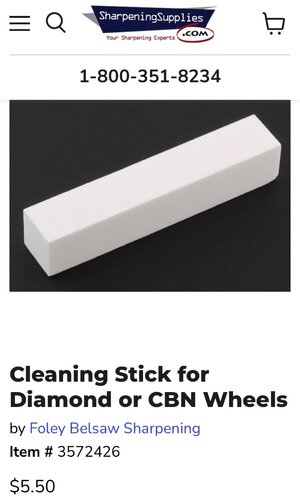
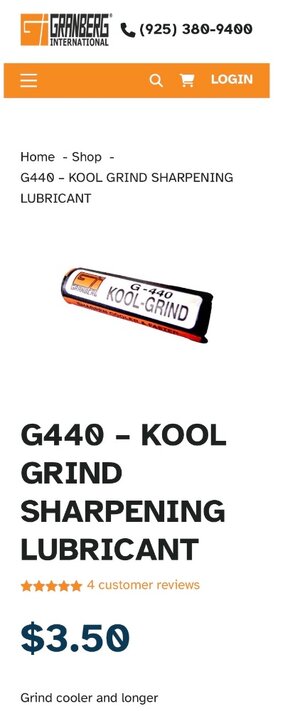
Yes, I just increased the angle a little more to keep the rounded edge doing the cutting, to simulate the shape you get when you round file. My machine scale says it's 55 degrees, but I don't know if that's accurate or not (it's a Vevor grinder that I went through and tightened up). I usually either hand file or use my Timberline sharpener when I'm doing cutter teeth, and the profile left by the grinder is now extremely close to what I get from those two methods. At 60 degrees with the CBN wheel, to get deep enough into the cut I was starting to catch the flat side surface of the wheel, and my profile would look a little like a square ground chain (just at the top of the tooth).
I never saw enough advantage in the 10 degree downward offset some chains call for to make it worth fooling with, so I always leave my clamp table flat at 0 degrees. If I was racing, the slight radius change might be worthwhile, I don't know. I always use a 30 degree cross angle because I'm almost always cutting some pine mixed in with various hardwoods.
I seldom drag out my grinder, but I've been using it a lot here lately with a diamond wheel because I've been using carbide-toothed chains to cut old pine stumps out of some pasture fields. The teeth hold up well, but the combination of pitch-impregnated wood, dry dusty rotted wood, and dirt play hob on the rest of the chain and the bar. Dries the oil right up. I hand-oil before every cut with a small squeeze bottle but one chain has already "stretched" so much that I'm almost out of adjustment on the tensioner. I'm thinking I may be able to use it on a 72-DL bar now (it's a 70-DL chain) but I haven't tried it yet.
I have another grinder I use much more often - it's set up just for grinding depth gauges, and I use a regular stone wheel that I've profiled to leave a rounded/sloped profile on the forward edge of the gauge tooth. Once I figure out what I'm after on the depth and get my settings right, the grinder makes it simple and easy to keep every tooth the same, much more consistent than multiple strokes of different angles from a hand file, especially on chains with double gauge teeth like the Oregon LPX chain.
I hope this makes sense and answers your question (and then some - LOL).