






You are using an out of date browser. It may not display this or other websites correctly.
You should upgrade or use an alternative browser.
You should upgrade or use an alternative browser.
Stock and Modded “can” mufflers vs pipes - an honest discussion without any attitude
- Thread starter Fabulous
- Start date


Ketchup
Epoxy member
- Local time
- 3:07 PM
- User ID
- 5594
- Joined
- Mar 12, 2018
- Messages
- 2,518
- Reaction score
- 8,479
- Location
- Colorado

Sure, I’ll bite.
So you seem convinced that a dual outlet crack-pipe (sorry, I’ve always called it that because the single outlet ones kind of look like a crack pipe) will make more power than the OEM muffler with two outlets of the same dimensions.
Do you have evidence of this?
What is the mechanism that allows the crack-pipe to create more power?
So you seem convinced that a dual outlet crack-pipe (sorry, I’ve always called it that because the single outlet ones kind of look like a crack pipe) will make more power than the OEM muffler with two outlets of the same dimensions.
Do you have evidence of this?
What is the mechanism that allows the crack-pipe to create more power?
Ketchup
Epoxy member
- Local time
- 3:07 PM
- User ID
- 5594
- Joined
- Mar 12, 2018
- Messages
- 2,518
- Reaction score
- 8,479
- Location
- Colorado
I also have some specific questions about expansion chamber pipes:
How many degrees of rotation can the pressure wave force charge back into the cylinder?
What is the ideal angle to reflect the sound wave?
Does the length of the stinger pipe have a significant effect on performance?
Is there an ideal ratio of stinger ID to exhaust port area?
How many degrees of rotation can the pressure wave force charge back into the cylinder?
What is the ideal angle to reflect the sound wave?
Does the length of the stinger pipe have a significant effect on performance?
Is there an ideal ratio of stinger ID to exhaust port area?

edisto
Super OPE Member
Sure, I’ll bite.
Good luck with that.
To address some of your questions in a general way, the duration of the positive pulse will depend on the abruptness of the constriction. A cone increases the duration at the cost of pressure, making the power less "peaky".
The reflected wave occurs due to a constriction, and that constriction should be perpendicular to flow. That said, pressure waves don't care about bends and elbows, so the approach to the constriction can be convoluted.
Stinger length does matter, but the overall pipe length can be reduced without ill effect by having the inlet of the stinger pushed inside of the cone.
Last edited:

farminkarman
I like the red & black ones
- Local time
- 4:07 PM
- User ID
- 13535
- Joined
- Aug 17, 2020
- Messages
- 5,027
- Reaction score
- 29,065
- Location
- Neenah Wisconsin
Good ol Fabz… I wonder how long it will be until he tries to come back with a different usernameGood luck with that.
Ketchup
Epoxy member
- Local time
- 3:07 PM
- User ID
- 5594
- Joined
- Mar 12, 2018
- Messages
- 2,518
- Reaction score
- 8,479
- Location
- Colorado
Good luck with that.
To address some of your questions in a general way, the duration of the positive pulse will depend on the abruptness of the constriction. A cone increases the duration at the cost of pressure, making the power less "peaky".
Thanks for the reply. Good to know about the cone angle effecting the duration. If I understand you right, a less steep angle will have more duration, widening the RPM range where the pipe is successfully backstuffing. The tradeoff is the pulse wave is less powerful.
I’m assuming there is still a relatively small range of effectiveness in the piston cycle. Can backstuffing occur with the transfers still open?
Good ol Fabz… I wonder how long it will be until he tries to come back with a different username
He destroyed the old thread pretty quickly, but he did stimulate some other folks to make good posts. It’s a shame the old thread got locked.
And if someone can make a convincing argument for crack-pipes, I’m here for that. A lot of folks in that camp seem high on their own supply, but if it actually makes gains I want to know why.

- Local time
- 2:07 PM
- User ID
- 26879
- Joined
- Jun 7, 2023
- Messages
- 1,811
- Reaction score
- 5,250
- Location
- Norcal
A YouTube scientist welded a "ramp" into a gutted muffler, engine side bottom of can to bottom of bark box that repeated 1/4 HP gains on a dyno.
farminkarman
I like the red & black ones
- Local time
- 4:07 PM
- User ID
- 13535
- Joined
- Aug 17, 2020
- Messages
- 5,027
- Reaction score
- 29,065
- Location
- Neenah Wisconsin
He trashed up @tree monkey 's thread pretty good too....He destroyed the old thread pretty quickly, but he did stimulate some other folks to make good posts. It’s a shame the old thread got locked.
And if someone can make a convincing argument for crack-pipes, I’m here for that. A lot of folks in that camp seem high on their own supply, but if it actually makes gains I want to know why.
Ketchup
Epoxy member
- Local time
- 3:07 PM
- User ID
- 5594
- Joined
- Mar 12, 2018
- Messages
- 2,518
- Reaction score
- 8,479
- Location
- Colorado
I’d like to see that. Can you find it again?A YouTube scientist welded a "ramp" into a gutted muffler, engine side bottom of can to bottom of bark box that repeated 1/4 HP gains on a dyno.
edisto
Super OPE Member
Thanks for the reply. Good to know about the cone angle effecting the duration. If I understand you right, a less steep angle will have more duration, widening the RPM range where the pipe is successfully backstuffing. The tradeoff is the pulse wave is less powerful.
That is my understanding.
I’m assuming there is still a relatively small range of effectiveness in the piston cycle. Can backstuffing occur with the transfers still open?
Technically, the "stuffing" part (supercharging) doesn't begin untiI the transfers are closed enough to limit blowby, but believe that the pressure wave starts on the upstroke of the piston, so some of the charge pushed back into the cylinder would be pushed into the transfers initially.
And if someone can make a convincing argument for crack-pipes, I’m here for that. A lot of folks in that camp seem high on their own supply, but if it actually makes gains I want to know why.
Definitely. If there is physics involved beyond lowering or delaying backpressure, I'd love to hear it.
Unfortunately, for some people, YouTube "likes" qualify as evidence.

- Local time
- 2:07 PM
- User ID
- 232
- Joined
- Dec 24, 2015
- Messages
- 9,761
- Reaction score
- 67,137
- Location
- Coastal Oregon
Thanks for the reply. Good to know about the cone angle effecting the duration. If I understand you right, a less steep angle will have more duration, widening the RPM range where the pipe is successfully backstuffing. The tradeoff is the pulse wave is less powerful.
I’m assuming there is still a relatively small range of effectiveness in the piston cycle. Can backstuffing occur with the transfers still open?
He destroyed the old thread pretty quickly, but he did stimulate some other folks to make good posts. It’s a shame the old thread got locked.
And if someone can make a convincing argument for crack-pipes, I’m here for that. A lot of folks in that camp seem high on their own supply, but if it actually makes gains I want to know why.
I locked the thread to clean it up - I'm with you, there was an excellent discussion going on until it got off the rails. I apologize to those upstanding members whose posts I deleted - it's open again.

- Local time
- 4:07 PM
- User ID
- 714
- Joined
- Jan 28, 2016
- Messages
- 4,145
- Reaction score
- 29,907
- Location
- Dike, Iowa
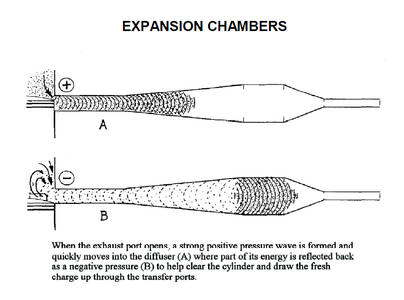
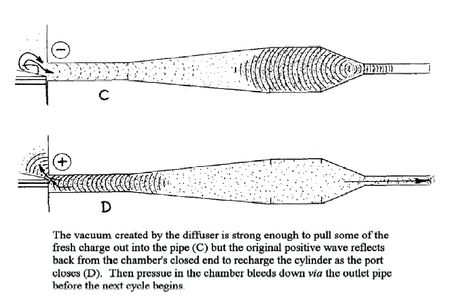
Ketchup
Epoxy member
- Local time
- 3:07 PM
- User ID
- 5594
- Joined
- Mar 12, 2018
- Messages
- 2,518
- Reaction score
- 8,479
- Location
- Colorado
Okay, so potentially an expansion chamber could achieve 30ish degrees of supercharge if the blowdown were that long.Technically, the "stuffing" part (supercharging) doesn't begin untiI the transfers are closed enough to limit blowby, but believe that the pressure wave starts on the upstroke of the piston, so some of the charge pushed back into the cylinder would be pushed into the transfers initially.
What effect does the length of the stinger create? Does it matter if the stinger exits in the side of the reflector cone?
Last edited:

- Local time
- 5:07 PM
- User ID
- 360
- Joined
- Dec 31, 2015
- Messages
- 23,533
- Reaction score
- 150,488
- Location
- East Jordan, MI
Not the ramp in particular like you mentioned, but I believe in the other thread I commented about bigger holes, easier pathways, exhaust coming straight out the front versus coming out the side… anything that allows the airflow or exhaust a straighter path will raise the horsepower. And on a dyno, the torque always follows the horsepower so it will go up as well. But that horsepower range gets narrow and what we perceive as torque while cutting will go downA YouTube scientist welded a "ramp" into a gutted muffler, engine side bottom of can to bottom of bark box that repeated 1/4 HP gains on a dyno.
Mad Professor
Pinnacle OPE Member
- Local time
- 5:07 PM
- User ID
- 14251
- Joined
- Oct 21, 2020
- Messages
- 547
- Reaction score
- 2,402
- Location
- Northeast USA
This thread has me doing flashbacks to my dirtbike/motocross days as a teenager already.........
- Local time
- 2:07 PM
- User ID
- 26879
- Joined
- Jun 7, 2023
- Messages
- 1,811
- Reaction score
- 5,250
- Location
- Norcal
I remember seeing that. Anyone tried a cone that goes big to small straight from engine to exit and fits behind the front plate?Not the ramp in particular like you mentioned, but I believe in the other thread I commented about bigger holes, easier pathways, exhaust coming straight out the front versus coming out the side… anything that allows the airflow or exhaust a straighter path will raise the horsepower. And on a dyno, the torque always follows the horsepower so it will go up as well. But that horsepower range gets narrow and what we perceive as torque while cutting will go down
Another thing this YouTube scientist found with the bark box is that it's irregular shaped exit faired slightly better than a round one the same size.
- Local time
- 2:07 PM
- User ID
- 26879
- Joined
- Jun 7, 2023
- Messages
- 1,811
- Reaction score
- 5,250
- Location
- Norcal
It's this one and maybe another that overlaps.I’d like to see that. Can you find it again?
edisto
Super OPE Member
Okay, so potentially an expansion chamber could achieve 30ish degrees of supercharge if the blowdown were that long.
What effect does the length of the stinger create? Does it matter if the stinger exits in the side of the reflector cone?
The stinger length and diameter are sized to generate pressure in the chamber, which is why a good portion of the length can be inside the chamber. Because of that, I imagine it would be possible to have a side exit. The issue with that is that you would want the entire length of the stinger outside of the chamber so that it wouldn't interfere with the reflected pressure wave.
- Local time
- 5:07 PM
- User ID
- 360
- Joined
- Dec 31, 2015
- Messages
- 23,533
- Reaction score
- 150,488
- Location
- East Jordan, MI
Some race saw guys will whack a big hole out the front and install a square pipe all the way back to the inside of the muffler where it bolts to the cylinder and weld it on both endsI remember seeing that. Anyone tried a cone that goes big to small straight from engine to exit and fits behind the front plate?

bwalker
Pinnacle OPE Member
- Local time
- 5:07 PM
- User ID
- 523
- Joined
- Jan 12, 2016
- Messages
- 2,107
- Reaction score
- 4,941
- Location
- Montana
All of those factors very with RPM. Stinger diameter controls how hot the pipe snd engine runs. To small and you will burn it down, to large and the pipe doesn't work well.I also have some specific questions about expansion chamber pipes:
How many degrees of rotation can the pressure wave force charge back into the cylinder?
What is the ideal angle to reflect the sound wave?
Does the length of the stinger pipe have a significant effect on performance?
Is there an ideal ratio of stinger ID to exhaust port area?
Similar threads

- Replies
- 0
- Views
- 2K

- Replies
- 8
- Views
- 7K


- Replies
- 102
- Views
- 18K

