



High Quality Chainsaw Bars Husqvarna Toys Hockfire Saws

Chain Technical Information

Philbert

Chainsaw Enthusiast
Local time
8:48 PM
User ID
737
Joined
Jan 30, 2016
Messages
4,998
Reaction score
21,306
Location
East Dakota
Country flag
General Sawchain Knowledge and Terminology - or, How to Become a Chain Nerd.


These references have likely been posted here before, but are worth repeating, especially, for newer folks.

They contain valuable and authoritative, technical information that applies to ALL brands of saw chain. As well as some information on bars, sprockets, etc.

*Note that versions of these are available on different sites, and in different languages. If a link does not work, try searching by the name of each document.

Oregon Maintenance and Safety Manual


STIHL Sharp Advice for Chain Saw Owners


Pferd Tools for Forestry


Philbert
 

hacskaroly

2100 Fanclub Member
Yearly GoldMember
Local time
6:48 PM
User ID
27954
Joined
Nov 24, 2023
Messages
2,788
Reaction score
8,987
Location
Northern Idaho, Ehh
Country flag
I’d not seen the Pferd manual before. Good resources, thank you!
We had a Stihl, Husqvarna and Oregon manuals/catalogs at work in a drawer at our workstation. I had lots of questions when I first started working there about chainsaws, bars, chains...etc... and my coworkers could only answer so many and after that it was "I don't know". I started looking through those and was finding answers to all sorts of questions and learned quite a bit. When asked where I was getting all of my information I told them the manuals/catalogs had all the info and they basically just said, "hmmmm" and anytime they or a customer they were working with had a question after that, they would ask me instead of looking it up themselves...smh. 🤣
 

Woodtroll

Super OPE Member
Local time
9:48 PM
User ID
30208
Joined
Oct 7, 2024
Messages
177
Reaction score
530
Location
Mtns of SW VA
Country flag
We had a Stihl, Husqvarna and Oregon manuals/catalogs at work in a drawer at our workstation. I had lots of questions when I first started working there about chainsaws, bars, chains...etc... and my coworkers could only answer so many and after that it was "I don't know". I started looking through those and was finding answers to all sorts of questions and learned quite a bit. When asked where I was getting all of my information I told them the manuals/catalogs had all the info and they basically just said, "hmmmm" and anytime they or a customer they were working with had a question after that, they would ask me instead of looking it up themselves...smh. 🤣

I'm a reader anyway, and I really appreciate reference material on subjects I'm interested in. I have a Carlton chain manual in PDF form I came across some years ago, and the recurring theme throughout the whole manual was "if your saw's not cutting right, 90% of the time it's because it's not sharpened right", to include the depth gauge settings. They were pushing the File-O-Plate, I believe it was called, at that time. I don't think it's still made (?), but was similar to the progressive depth plates West Coast saw is selling now. The latest Carlton manual I have is much different, but still interesting.
 

Philbert

Chainsaw Enthusiast
Local time
8:48 PM
User ID
737
Joined
Jan 30, 2016
Messages
4,998
Reaction score
21,306
Location
East Dakota
Country flag

sundance

Super OPE Member
Local time
9:48 PM
User ID
888
Joined
Feb 14, 2016
Messages
102
Reaction score
237
Location
SW PA
Country flag
I'm a reader anyway, and I really appreciate reference material on subjects I'm interested in. I have a Carlton chain manual in PDF form I came across some years ago, and the recurring theme throughout the whole manual was "if your saw's not cutting right, 90% of the time it's because it's not sharpened right", to include the depth gauge settings. They were pushing the File-O-Plate, I believe it was called, at that time. I don't think it's still made (?), but was similar to the progressive depth plates West Coast saw is selling now. The latest Carlton manual I have is much different, but still interesting.
If it's a PDF can you post it? Probably interesting.
 

Philbert

Chainsaw Enthusiast
Local time
8:48 PM
User ID
737
Joined
Jan 30, 2016
Messages
4,998
Reaction score
21,306
Location
East Dakota
Country flag
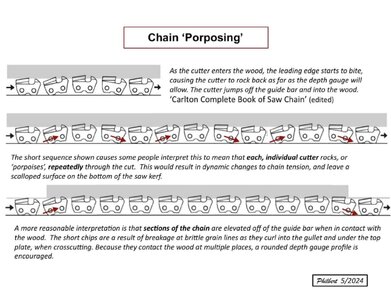
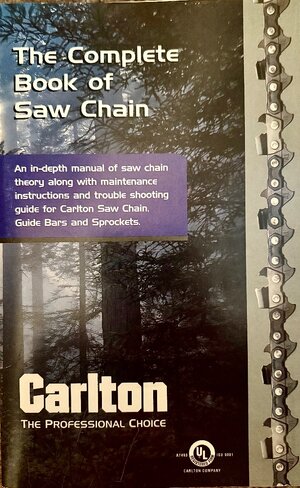
One issue, based on a short illustration in the ‘Carlton Complete Book of Saw Chain’ is the concept of ‘chain porposing’

Some people believe that each cutter repetitively, and continuously, undulates, through each pass, as a result.

This would entail multiple cutters in a loop chaotically rocking back and forth simultaneously, creating erratic changes in chain tension.

My understanding is that each cutter rocks back, when entering the cut, and remains in that elevated, cutting position, until leaving the cut.

This would describe a section of engaged chain rising slightly off the guide rail bars, with cutters entering and leaving as the chain rotates through the wood.

I tried to illustrate that in the attached drawing.

IMG_2278.jpeg

Philbert
 

Woodtroll

Super OPE Member
Local time
9:48 PM
User ID
30208
Joined
Oct 7, 2024
Messages
177
Reaction score
530
Location
Mtns of SW VA
Country flag

IffykidMn

Super OPE Member
Local time
8:48 PM
User ID
18222
Joined
Aug 13, 2021
Messages
405
Reaction score
1,162
Location
Minnesota
Country flag
I'm a reader anyway, and I really appreciate reference material on subjects I'm interested in. I have a Carlton chain manual in PDF form I came across some years ago, and the recurring theme throughout the whole manual was "if your saw's not cutting right, 90% of the time it's because it's not sharpened right", to include the depth gauge settings. They were pushing the File-O-Plate, I believe it was called, at that time. I don't think it's still made (?), but was similar to the progressive depth plates West Coast saw is selling now. The latest Carlton manual I have is much different, but still interesting.
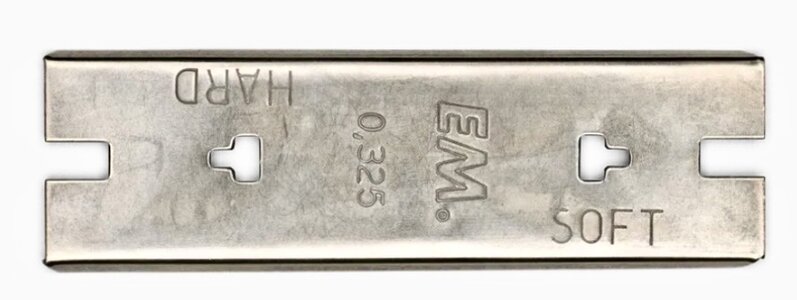
File-O-Plate would be correct, I still have several as the saw shop I frequented gave them away anytime you bought 3 or more loops of chain.
WCS depth plates are very similar with the exception of 4 choices of depth rather than the soft or hard of the File-O-Plate.
 

Philbert

Chainsaw Enthusiast
Local time
8:48 PM
User ID
737
Joined
Jan 30, 2016
Messages
4,998
Reaction score
21,306
Location
East Dakota
Country flag
File-O-Plate would be correct, I still have several as the saw shop I frequented gave them away anytime you bought 3 or more loops of chain.
WCS depth plates are very similar with the exception of 4 choices of depth rather than the soft or hard of the File-O-Plate.
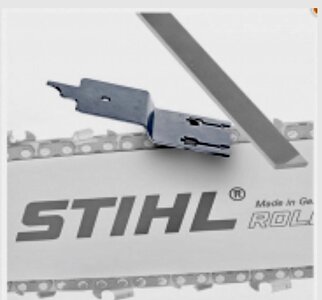
Husqvarna and STIHL also have versions of ‘progressive depth gauge’ plates.

IMG_2280.jpeg
IMG_2282.jpeg

Philbert
 
Last edited:

Woodtroll

Super OPE Member
Local time
9:48 PM
User ID
30208
Joined
Oct 7, 2024
Messages
177
Reaction score
530
Location
Mtns of SW VA
Country flag
One issue, based on a short illustration in the ‘Carlton Complete Book of Saw Chain’ is the concept of ‘chain porposing’

Some people believe that each cutter repetitively, and continuously, undulates, through each pass, as a result.

This would entail multiple cutters in a loop chaotically rocking back and forth simultaneously, creating erratic changes in chain tension.

My understanding is that each cutter rocks back, when entering the cut, and remains in that elevated, cutting position, until leaving the cut.

This would describe a section of engaged chain rising slightly off the guide rail bars, with cutters entering and leaving as the chain rotates through the wood.

I tried to illustrate that in the attached drawing.

View attachment 478264

Philbert

I think the long strings you get when "noodling" with the grain tells you that an individual tooth does not chatter in and out of the wood with each pass, as in the middle diagram. I believe that, when bucking, the chip length is determined to some extent by the chips breaking at the growth rings, as you say in the bottom diagram.
 

heimannm

Mastermind Approved!
GoldMember
Local time
8:48 PM
User ID
714
Joined
Jan 28, 2016
Messages
4,009
Reaction score
28,507
Location
Dike, Iowa
Country flag
20230108_134059.jpg

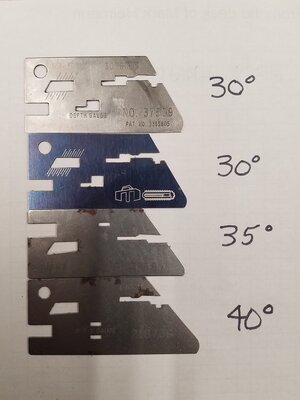
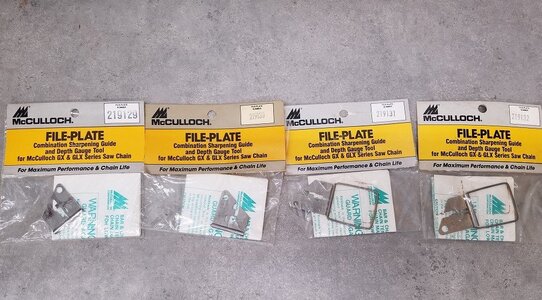
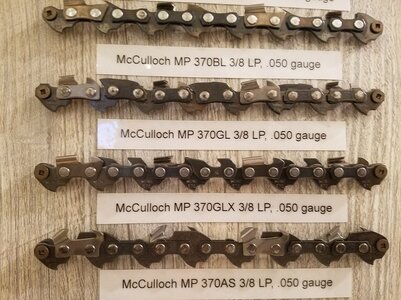
I do not have any of the original Carlton 37509 available, but I do have a few of the others. The blue one is as close to 37509 and I could make it to the original Carlton. The bottom 2 are McCulloch branded, I don't know what kind of arrangements they made with Carlton at the time.

Mark
 

Philbert

Chainsaw Enthusiast
Local time
8:48 PM
User ID
737
Joined
Jan 30, 2016
Messages
4,998
Reaction score
21,306
Location
East Dakota
Country flag
I do not have any of the original Carlton 37509 available, but I do have a few of the others.
As I recall, the File-O-Plates were multi-function, beyond just depth gauge tools. Your photo reminds me of that.

Like a skilled carpenter can use a framing square to draw circles & elipses, calculate stair and roofing angles, do algebra, predict sunset times and rainfall, etc. (OK, maybe not the weather stuff).

Can you give us a ‘tour’ of the various slots?

Thanks!

Philbert
 

heimannm

Mastermind Approved!
GoldMember
Local time
8:48 PM
User ID
714
Joined
Jan 28, 2016
Messages
4,009
Reaction score
28,507
Location
Dike, Iowa
Country flag
The File-O-Plates tend to be very chain specific, one that fits properly on Carlton 3/8" chisel chain will probably not fit 3/8" semi-chisel chain and may not fit another manufacturer 3/8" chisel chain, just be aware.

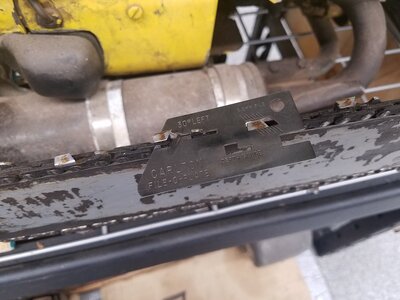
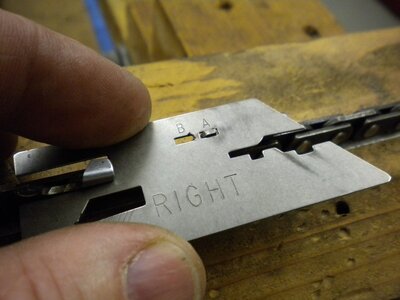
In this photo the plate it correctly oriented for filing the LH cutter, the angle on the plate provides a visual guide and the plate fits below the file to keep the file at the correct height in the cutter. The temptation is to press the file hard against the plate to keep it low enough, but doing that repeatedly just dulls the file that much more quickly. The scale in the front promotes keeping all of the cutters the same length. If you use the depth gauge orientation this is not so critical since this is a "progressive" gauge and adjusts the height of the depth gauge based on the cutter height.

20230108_131527.jpg

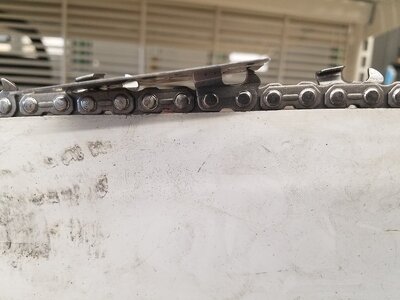
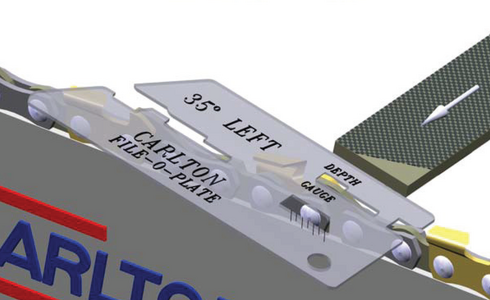
Here you can see how the front of the File-O-Plate rests on the depth gauge of the cutter ahead of the cutter you are filing. If I remember the Carlton instructions correctly, they recommended filing the depth gauges first, then the cutters but I always did it in the opposite sequence (cutters first, depth gauges last) and had very good results.

20230108_131852.jpg

This photo shows how the plate works to keep the file at the correct height/depth in the cutter tooth.

DSCN1645.jpg

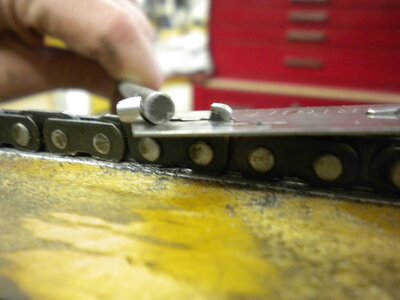
Here you can see the File-O-Plate moved into position for filing the depth gauge. The "A" and "B" slots are sometimes designated "hard" and "soft" with less clearance provided in the "A" position and more in the "B" position. I never tried to measure the actual relief of the depth gauges, and it would change as the tooth is filed back in any case. In general, the depth gauge will be 0.020" to 0.030" below the cutter height for best performance. Less clearance will be smoother but slower cutting, more clearance can make the chain too grabby for casual users or low power saws.

DSCN1640.jpg

There are some other variations of the File-O-Plates for use with chains equipped with bumper or guard links, often referred to as low-vibration or safety chain.

20220408_075608.jpg

If I can't find a photo of one in position I will see about getting some photos, or at least a copy of the instructions showing the File-O-Plate in position on those types of chains.

Mark
 

heimannm

Mastermind Approved!
GoldMember
Local time
8:48 PM
User ID
714
Joined
Jan 28, 2016
Messages
4,009
Reaction score
28,507
Location
Dike, Iowa
Country flag
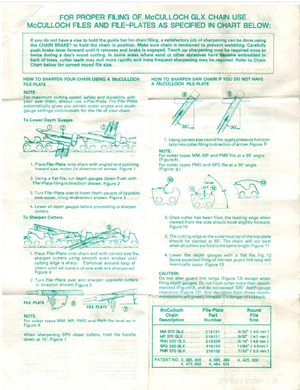
FWIW here is the McCulloch page demonstrating the use of the File-O-Plate on GLX type chain.

1766962283834.png

The third chain down is MP370 GLX, 3/8 LP chain with the GLX aka Shark Fin type guard links.

20231028_081120.jpg

Mark
 
Top